+86 13600513715


Please provide a verifiable expert’s name and source for the quotation. No article or source material was included, and I can’t invent an expert attribution or present a fabricated quote as genuine.
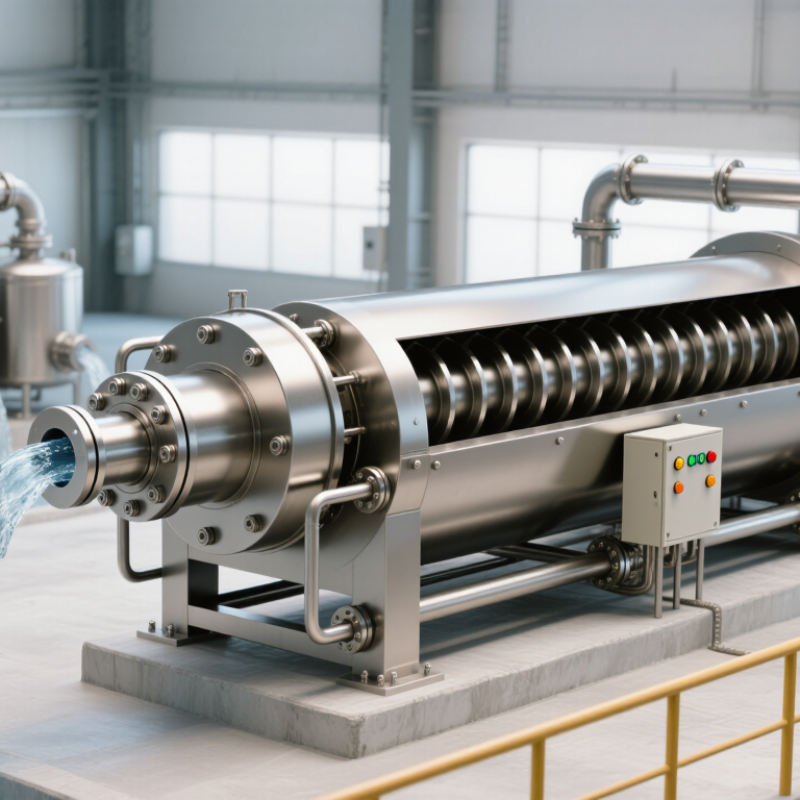
A sludge dewatering screw press separates water from solids in a slow, continuous process. Feed sludge enters a screened cylinder, often after polymer conditioning helps fine particles bind into larger flocs. In the inlet zone, gravity drains free water through small openings. You may see filtrate running into a trough while the solids move forward. It is not magic.
Inside the press, a rotating screw carries sludge toward the discharge. The screw’s changing pitch and the narrowing space gradually compress the material. As resistance rises, more water escapes through the screen, while the solids form a drier cake near the outlet. An adjustable cone or similar backpressure device can help control discharge pressure. Too much pressure may increase wear or cause unstable operation; too little can leave a wet cake.
Actual performance depends on the sludge, not just the machine. Fibrous sludge, biological sludge, and variable feed solids can behave quite differently. Polymer dose, screen condition, screw speed, and feed rate all matter. Operators should compare cake dryness, filtrate clarity, throughput, and cleaning needs during trials. A neat process diagram hides the awkward part: real sludge changes from shift to shift. Leave room for tuning.
Before comparing screw presses, identify what enters the machine on an ordinary day and during peak loads. Record solids concentration, flow rate, temperature, and changes across shifts; one grab sample can hide a difficult afternoon. Measure the swings. Note whether the sludge is biological, oily, fibrous, or mineral-rich, and check for grit that could increase wear. These details affect screening, conditioning, and equipment sizing.
Define treatment goals in measurable terms. Set target cake dryness, solids capture, filtrate quality, and operating hours before requesting performance estimates. Clarify whether the cake must meet a specific handling or disposal requirement. Ask how polymer dose is established and whether trials use your actual sludge. A clean-looking laboratory sample may not represent a cold Monday feed. That matters.
Compare trial results with your own priorities, not just a headline capacity figure. Watch cake discharge, filtrate clarity, wash-water use, and staff attention during a sustained run. I would not trust one tidy test result alone; sludge changes, and operators may need to adjust conditioning. Keep samples from different production periods, including the awkward ones. A press that performs well on average may still struggle during short, high-solids peaks.
How to Choose a Sludge Dewatering Screw Press in 2026
Calculate Required Capacity and Dewatering Performance
Size the press around dry-solids loading, not feed volume alone. Measure daily sludge flow and total solids over representative operating days, including wet-weather or production peaks. For example, 40 m³/day at 2% solids contains about 800 kg of dry solids daily. If the press runs eight hours, that is 100 kg dry solids per hour. At 25% cake solids, the resulting cake weighs roughly 3.2 tonnes per day. The U.S. EPA’s 2016 national biosolids report estimated about 4.5 million dry metric tons generated annually, underscoring the scale of solids handling. But national totals cannot predict your site’s sludge behavior.
Check both hydraulic capacity and dry-solids capacity against supplier data, then confirm performance with a representative sludge test. Record cake solids, filtrate quality, polymer dose, and throughput; one good test may not reflect seasonal changes. Water Environment Federation design guidance treats solids loading and hydraulic loading as separate checks. Set a realistic operating schedule and include time for cleaning and maintenance. A modest reserve can help, though the right allowance depends on feed variability and available storage.
Tips: Run tests on actual sludge, not water. Compare results at several polymer doses. Track kilograms of dry solids per hour, not just tonnes of wet cake. Recheck after process changes; feed conditions can shift, and the first estimate may be wrong.
How to Choose a Sludge Dewatering Screw Press in 2026
Compare press designs, controls, and operating costs
Press design should match the sludge, not just the plant’s daily flow rate. Multi-disc units use moving and fixed rings to release filtrate while limiting screen blockage. Check ring gaps, screw pitch, and access for cleaning. Fibrous sludge may behave differently from biological sludge, even at similar feed solids. Ask suppliers to test representative samples.
Controls affect both consistency and operator workload. A basic panel may rely on manual speed and water adjustments. More advanced controls can track torque, feed rate, and wash-water use, then flag unusual changes. Useful alarms are specific. “High torque” helps more than a vague fault light. Still, automation cannot correct poor polymer selection or unstable feed.
Compare the full operating bill. Include polymer, electricity, wash water, replacement rings, labor, and cake hauling. A press with modest power demand may use more polymer if conditioning is poorly tuned. Request trial data showing feed solids, cake solids, and polymer dose under stated conditions. Check the test method, too. One short trial may miss seasonal changes. Leave room in the estimate for adjustments; real sludge rarely follows a perfect spreadsheet.
| Comparison Area | Option or Measure | Typical Characteristics | Selection and Operating Considerations |
|---|---|---|---|
| Press design | Multi-disc screw press | Alternating fixed and moving rings form a slowly advancing, self-cleaning drainage zone around the screw. | Often suited to continuous sludge dewatering where low-speed operation and reduced screen blinding are priorities. Check ring clearance, wear-part access, and the supplier’s sludge-specific performance data. |
| Press design | Perforated-screen or wedge-wire screw press | A rotating screw conveys sludge through a screened drainage section; screen openings and geometry vary by design. | Compare screen-cleaning provisions, abrasion resistance, and the risk of blinding with fibrous or sticky feed. Confirm that the screen specification is appropriate for the sludge and filtrate-quality requirements. |
| Feed sludge | Municipal waste-activated or mixed sludge | Performance varies with feed solids, volatile-solids content, temperature, and conditioning. Cake solids around 15–25% are a broad planning range for many municipal applications, not a guarantee. | Request a trial using representative sludge. Compare cake solids, solids capture, filtrate quality, polymer demand, and stable throughput together rather than relying on cake-solids figures alone. |
| Feed preparation | Polymer conditioning and feed control | Polymer type, dose, dilution, aging, and mixing affect floc formation and dewatering. A preliminary dose may be evaluated over a test range such as 3–10 kg of active polymer per tonne of dry solids. | Treat the range as a trial-planning guide, not a design specification. Optimize dose against filtrate quality, cake solids, and cost; verify whether the quoted dose is on an active-polymer or product basis. |
| Controls | Basic local control | Typically includes motor starters or variable-frequency drives, local start/stop controls, and basic alarms. | Can suit attended, straightforward installations. Confirm interlocks, overload protection, emergency stops, and alarm visibility before purchase. |
| Controls | PLC-based automatic control | May coordinate sludge feed, polymer dosing, screw speed, and backpressure using operator-setpoints and available process signals. | Useful for changing loads and unattended operation. Specify sensor requirements, manual fallback, data logging, remote alarms, and compatibility with the plant’s control system. |
| Energy | Electricity consumption | A preliminary comparison range of roughly 20–100 kWh per tonne of dry solids may be used for screening; actual use depends on equipment size, feed, operating rate, and auxiliaries. | Ask for measured or guaranteed consumption at the stated feed condition. Include feed pumps, polymer systems, and wash-water equipment consistently when comparing proposals. |
| Maintenance | Wear parts, cleaning, and service access | Typical inspection points include the screw, screen or rings, seals, bearings, drive components, and spray-cleaning equipment where fitted. | Compare expected inspection intervals, replacement-part costs, labor hours, lifting requirements, and access for cleaning. Site sludge abrasiveness and operating hours influence service needs. |
| Operating cost example | Illustrative variable-cost calculation per tonne of dry solids | At 5 kg active polymer/t dry solids and an assumed polymer price of $4/kg: $20/t. At 50 kWh/t dry solids and electricity at $0.12/kWh: $6/t. Illustrative subtotal: $26/t dry solids. | Assumptions are examples, not market quotations. The subtotal excludes labor, maintenance, water, capital cost, and cake transport or disposal. Replace the inputs with local prices and trial results. |
| Final selection | Lifecycle comparison | Compare installed cost, dry-solids capacity, cake solids, solids capture, polymer use, energy, maintenance, and operator requirements at the same sludge and operating conditions. | Use a sludge trial and a lifecycle-cost model. Confirm the basis of every quoted figure, expected operating hours, redundancy needs, and the cost of handling the resulting cake. |

Note: Performance and cost figures are indicative screening values. Actual results depend on sludge characteristics, conditioning, equipment configuration, and site conditions; verify them with representative testing and supplier documentation.
A sludge dewatering screw press should fit your process, not just its advertised capacity. In 2026, verify that the proposed materials, electrical components, guarding, and documentation meet the requirements applicable to your site. Ask for written confirmation, not a verbal assurance. Compare the stated throughput with sludge solids, flow variation, and polymer conditions from your own operation. A small test using representative sludge can reveal blinding or inconsistent cake dryness. Real sludge behaves differently.
Maintenance needs become clearer when you inspect access points and routine service steps. Can operators reach the spray bars, screens, and screw without awkward lifting? Ask how often wear parts need inspection under similar operating conditions, and request a realistic replacement schedule. Check whether common spares are available locally and whether the supplier provides clear procedures, training, and troubleshooting support. Response time matters during an unexpected stoppage. I would also ask for references from plants with comparable sludge, while remembering that one successful installation does not guarantee the same result at yours. A polished proposal can still leave practical questions unanswered.