 +86 13600513715
Leave Your Message
-
CONTACT NUMBER
-
 CONTACT NUMBER
 -
 CONTACT NUMBER
Choosing the best Aeration Diffuser in 2026 requires more than comparing bubble size or catalogue prices. It requires evidence from the tank, the blower room, and the maintenance log. The U.S. Environmental Protection Agency reports that aeration may consume 45–75% of a wastewater plant’s total energy. That figure changes the decision completely. A diffuser with higher oxygen transfer efficiency can reduce blower demand, but only when fouling, airflow, water depth, and operating cycles are considered together.
Dr. Bruce Rittmann, a leading wastewater treatment researcher, has stated, “Aeration is the most energy-intensive operation in biological wastewater treatment.” His observation remains practical for modern plant operators. A membrane diffuser may produce fine bubbles and strong oxygen transfer. However, its pores can clog under poor pretreatment or irregular cleaning. Coarse-bubble systems may waste more energy, yet they can offer better mixing in selected applications. The correct answer depends on wastewater characteristics, not marketing language.
The Water Environment Federation also emphasizes energy management, process control, and reliable oxygen delivery in treatment facilities. These priorities should guide every Aeration Diffuser comparison. Check standard oxygen transfer efficiency, pressure loss, material durability, cleaning requirements, and turndown performance. Ask for independent test data. Inspect the bubble pattern after installation.
Small details matter.
A clean-looking basin can hide uneven airflow. A low purchase price can create years of higher electricity costs. No diffuser is perfect. Even experienced teams can overvalue laboratory efficiency and undervalue field maintenance. This guide examines the trade-offs, available evidence, and practical selection criteria for choosing a dependable Aeration Diffuser in 2026.
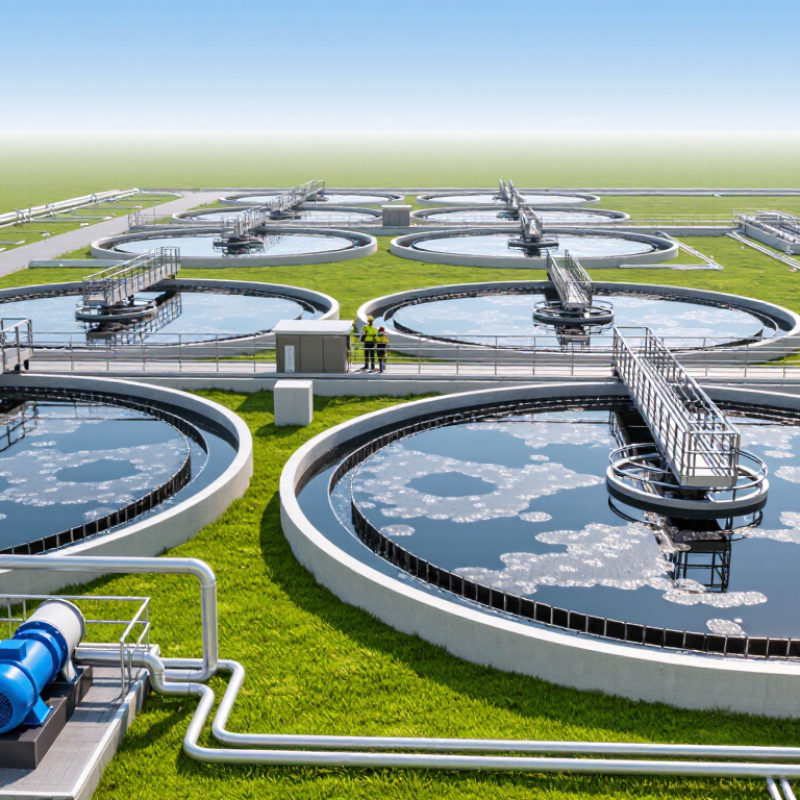
Aeration diffusers convert blower air into bubbles, but their operating principles differ sharply. Fine-bubble membrane diffusers use flexible pores to create small bubbles with greater surface area. Coarse-bubble diffusers release larger bubbles, improving mixing and reducing clogging risk. Tube, disc, panel, and ceramic designs all follow the same transfer principle: air must overcome hydrostatic pressure, then oxygen moves across the bubble-water boundary.
The selection should begin with oxygen demand, tank depth, wastewater characteristics, and cleaning access. The U.S. EPA reports that aeration may represent roughly 45–75% of a wastewater plant’s electricity use, so small efficiency losses become expensive. WEF Manual of Practice No. 32 also emphasizes site-specific oxygen-transfer testing, including standard oxygen transfer efficiency and alpha-factor correction. Fine bubbles often provide higher transfer efficiency, but grease, solids, and biofilm can block pores and increase pressure demand. That trade-off is easy to underestimate.
A useful field check measures dissolved oxygen at several tank locations, not only near the outlet. Compare blower pressure, airflow, and diffuser age against commissioning data. A stable reading can still hide poor mixing. I would also question laboratory results when wastewater chemistry changes seasonally; clean-water performance is not real-world performance. The best diffuser is therefore not simply the one with the smallest bubbles, but the one that maintains transfer, mixing, and serviceability under actual loading conditions.
| Diffuser Type | Operating Principle | Typical Bubble Size | Relative Oxygen Transfer | Energy Efficiency | Clogging Risk | Typical Applications | Key Selection Considerations |
|---|---|---|---|---|---|---|---|
| Fine-Bubble Disc | Air passes through small perforations in a flexible membrane, producing a dense cloud of small bubbles. | Approximately 1–3 mm under typical wastewater conditions. | High, because small bubbles provide a large gas–liquid contact area and rise relatively slowly. | High when operated at the correct airflow and submerged depth. | Medium; fouling, scaling, and biological growth can reduce airflow. | Municipal wastewater, industrial treatment, activated-sludge basins, and equalization tanks. | Check membrane material, effective service area, operating depth, airflow range, and cleaning access. |
| Fine-Bubble Tube | A long perforated or slotted membrane releases fine bubbles along the length of the tube. | Approximately 1–3 mm, depending on membrane design and air rate. | High; the extended active surface can provide uniform air distribution across long zones. | High, provided the air header is balanced and the membrane remains clean. | Medium; uneven air distribution may occur if sections foul or the manifold is poorly balanced. | Long aeration lanes, oxidation ditches, retrofit projects, and tanks requiring extended coverage. | Evaluate tube spacing, support method, header layout, replacement procedure, and resistance to abrasion. |
| Coarse-Bubble Disc or Tube | Larger openings generate bigger bubbles that create strong vertical mixing and circulation. | Generally larger than 3 mm; actual size varies with opening geometry and airflow. | Lower than fine-bubble systems for oxygen transfer, but effective for mixing. | Moderate for mixing duties; usually less efficient for oxygen transfer alone. | Low to medium; larger passages are generally less susceptible to blockage. | Equalization basins, grit chambers, sludge holding tanks, high-solids liquids, and mixing applications. | Choose when circulation, solids suspension, or fouling resistance is more important than maximum oxygen efficiency. |
| Ceramic or Rigid Porous | Compressed air is forced through a rigid porous body containing interconnected microscopic passages. | Fine bubbles, commonly around 1–3 mm when properly operated. | High initially, with performance depending strongly on pore cleanliness and air quality. | Moderate to high; pressure demand can increase as pores become blocked. | High in liquids containing oils, fibers, suspended solids, or scale-forming compounds. | Aquaculture, laboratory systems, clean-water aeration, and selected process applications. | Confirm water quality, filtration requirements, allowable backpressure, and the available cleaning method. |
| Perforated Pipe | Air exits through drilled holes or slots distributed along a pipe or lateral. | Usually medium to coarse; bubble size depends on hole diameter, airflow, and submergence. | Low to moderate for oxygen transfer, but useful for broad air distribution and mixing. | Moderate; pressure loss is often predictable and maintenance is relatively straightforward. | Low to medium; holes may clog if air is not filtered or condensate is not drained. | Open tanks, stormwater treatment, aquaculture raceways, and systems needing robust mixing. | Review hole spacing, pipe material, corrosion resistance, air filtration, and ease of flushing. |
| Jet or Ejector Aerator | A liquid jet draws in air through an ejector and disperses the air–liquid mixture into the tank. | Variable; typically larger and less uniform than membrane-generated bubbles. | Moderate; oxygen transfer is combined with strong hydraulic mixing. | Moderate; pumping energy must be included in the total operating cost. | Low at the air inlet, although pumps and nozzles require protection from solids. | Deep tanks, compact treatment units, lagoons, and applications requiring mixing and aeration together. | Compare total pump and blower power, nozzle wear, hydraulic capacity, noise, and access for maintenance. |